UK terminology
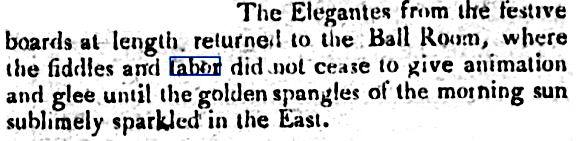
'taber' / 'tabor' meaning a pipe and tabor
1530 In a dispute about who owns a woodland:
“… Woodford in most cruel and unlawful manner sent to a 'mynstrell called a taberer'
to take his taber and to go 'pypyng into the seyd maner place.' The minstrel refused,…”A History of the County of Buckingham: Volume 3. Parishes: Dorney
1579 poem
"...I sawe a shole of shepeheardes outgoe,
With singing, and shouting, and iolly chere:
Before them yode a lustie tabrere,
That to the meynie a hornepipe plaid,
Whereto they dauncen eche one with his maide.To see these folkes make such jovisaunce,
Made my hart after the pipe to daunce..."‘The Shepheardes Calender: May’
1607 play:
"... Up then, I say, both young and old, both man and maid a-maying,
With drums and guns that bounce aloud, and merry tabor playing..."‘The Knight of the Burning Pestle’ by Francis Beaumont, page 122
1611 Freefolk, Hampshire; Sir Richard Paulet's Household Accounts:
"to speede for playing on ye taber xij d"'1612 Peter Hales, taberer' was fined 20s for keeping an unlicensed tippling house in the town in 1614. 1647 ballad
‘A proper new Ballad, intituled The Fairies farewel, or God a mercy Will, to be sung or whistled,
to the tune of the Medow Brow by the learned, by the unlearned to the tune of Fortune.’“…When Tom came home from labour, —
Or Cisse to milking Rose;
Then merrily went their Tabor
And nimbly went their Toes….”"Certain elegant poems, written by Dr. Corbet, Bishop of Norwich."
1775 poem ‘The delightful vocal companion; or, polite songster. Containing a curious collection of the best new songs, ... 1775’
1778 song 333. A PASTORAL.Sung at RANELAGH
“…Upon the smooth green, when the Shepherds advance,
To hail May's return, with the tabor and dance,…”‘The Vocal Magazine; or, British Songster's Miscellany; containing all the English, Scotch and Irish songs, cantatas, glees, catches,
airs, ballads, &c ‘ page 90Regency 1793 poem ‘Retirement’
“…Then let the tabor sound
— the dance we'll try…”‘Poems’ by Burrell, Sophia, Lady
1800 poem 'Your eyes have ta'en captive my heart'
"...The dance and the tabor I shun,
No rest on my pillow I find ;
Believe me, wherever I run,
Your image still dwells in my mind."In 'The Strawberry Tale', published in a collection of songs "which have been sung at Public Places of Amusement",
called 'The New Entertaining Frisky Songster'poem ' Fragment':
"A day of jubilee, and oft they bear,
Commix'd along the unfrequented shore,
The sound of village dance and tabor loud,
Startling the musing ear of Solitude.
Such is the jocund wake of Whitsuntide"'The Poetical Works of Henry Kirk White' 1785-1806
(born in Nottingham, died from brain fever whilst studying at Cambridge)1805 poem
“When shall I behold again, in one day, all the pleasing objects of my affection?—.....
Under the shade of a spreading elm, when shall I dance again to the sound of the tabor?”Translations of German Poetry in American Magazines 1741-1810 by Edward Ziegler Davis
Boston Weekly Mag., III-60, Feb. 2, 1805, Boston, USA1807 Ode:
"Then sing, ye Birds, sing, sing a joyous song!
And let the young Lambs bound
As to the tabor's sound!
We in thought will join your throng,
Ye that pipe and ye that play,
Ye that through your hearts to-day
Feel the gladness of the May!"'Intimations of Immortality' from Recollections of Early Childhood by William Wordsworth (1770-1850) (Wordsworth is describing how how his own view of nature has changed. The poem focuses on man's interaction and change through nature)
The British theatre : or, a collection of plays, which are acted at the Theatres Royal, Drury Lane, Covent Garden, and Haymarket ;
in twenty-five volumes.; with biographical and critical remarks, by Mrs. Inchbald, vol 201813 poem
“…And then the sounds of joy, — the beat
Of tabors and of dancing feet…”"The poetical works of Thomas Moore"
1813 in a poem on London:
" In Fleet strete then I heard a shoote :
I putt off my hatt, and I made no stave,
And when I came unto the rowte,
Good Lord ! I heard a taber playe,
For so, God save mee ! a Morrys-daunce :
Oh ! ther was sport alone for mee,
To see the Hobby-horse how he did praunce
Among the gingling company. "MS. Hart. 3910 From: John Brand's Observations on the Popular Antiquities of Great Britain: Chiefly Illustrating The Origin of Our Vulgar and Provincial Customs, Ceremonies and Superstitions, [Arranged, revised and greatly enlarged by Sir Henry Ellis], George Bell and Sons, London: 1908, vol. 1, pp. 212-270, originally published 1813
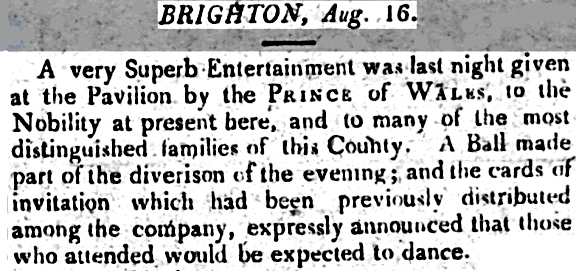
1814 dancing after dinner
Gloucester Journal - Monday 08 August 1814
top of page